Bathroom Safety for Aging Parents: The Professional Assessment Checklist You Can Use Today
Bathroom Safety for Aging Parents: The Professional Assessment Checklist You Can Use Today
You already know the bathroom is the most dangerous room in your parent's house. What you might not know is exactly what to look for when you walk in there, or how to tell the difference between a minor inconvenience and a fall waiting to happen.
Every week, we walk into bathrooms across South Florida and assess them for safety risks. Over the years, we have developed a systematic approach to evaluating every surface, fixture, and transition point in a bathroom. The goal is always the same: keep your loved one safe without turning their home into something that feels like an institution.
The good news is that you do not need a professional background to do a preliminary assessment yourself. You just need to know what to look for. Here is the same framework we use when we evaluate a client's bathroom, broken down so you can walk through your parent's bathroom this weekend and identify the risks that matter most.
The Three Pillars of Bathroom Safety
When we assess a bathroom, we are not randomly scanning the room and hoping something catches our eye. There is a structured approach that covers every major risk area. As we tell every family we work with:
"There's really three main things we're looking at. We're looking at the ability for someone to safely and comfortably get on and off a toilet. Somebody the ability to safely get in and out of the shower. And three, an environment that does not risk them falling when they're in the bathroom."
Those three pillars, toilet transfers, shower entry and exit, and the overall bathroom environmentcover roughly 95% of the fall risks we encounter. Every recommendation, every piece of equipment, and every modification we suggest ties back to one of those three areas.
What makes bathroom safety so tricky is that the risks evolve. Your parent might be managing fine today with a standard toilet and a step-over tub, but mobility can change gradually. A bathroom that was perfectly safe six months ago might be an accident waiting to happen now. That is why regular assessments matter, and why knowing what to look for puts you ahead of the curve.
Let us walk through each pillar in detail so you can evaluate your parent's bathroom with the same critical eye we bring to every consultation.
Pillar One: Toilet Transfers, Getting On and Off Safely
The toilet is often the first place where mobility challenges show up in the bathroom, and it is one of the most overlooked. Most standard toilets sit at about 15 inches, which might not sound low until you watch someone with hip pain, knee replacements, or general muscle weakness try to lower themselves down and push themselves back up multiple times a day.
What to Observe
Spend a few minutes watching how your parent actually uses the toilet. Not from inside the bathroom, just pay attention to the cues. Are they bracing themselves against the wall? Are they gripping the edge of the vanity or the toilet paper holder for support? Do they take an unusually long time? Do they seem winded or in pain when they come out?
Here is a quick self-assessment checklist for toilet transfers:
- Can they sit down in a controlled manner, or do they essentially drop the last few inches?
- Can they stand back up without grabbing something that was not designed to support their weight?
- Is there anything bolted to the wall near the toilet that could serve as a grab point, or are they relying on towel bars and countertops?
- Do they avoid using the bathroom at certain times because they know it will be difficult without help?
- Have they mentioned any near-missesmoments where they almost fell or felt unsteady?
If you answered yes to even one of these, it is time to look at solutions.
Solutions by Severity
Not every situation calls for the same intervention, and that is where a lot of families get stuck. They assume the options are either "do nothing" or "full bathroom renovation." In reality, there is a spectrum of solutions.
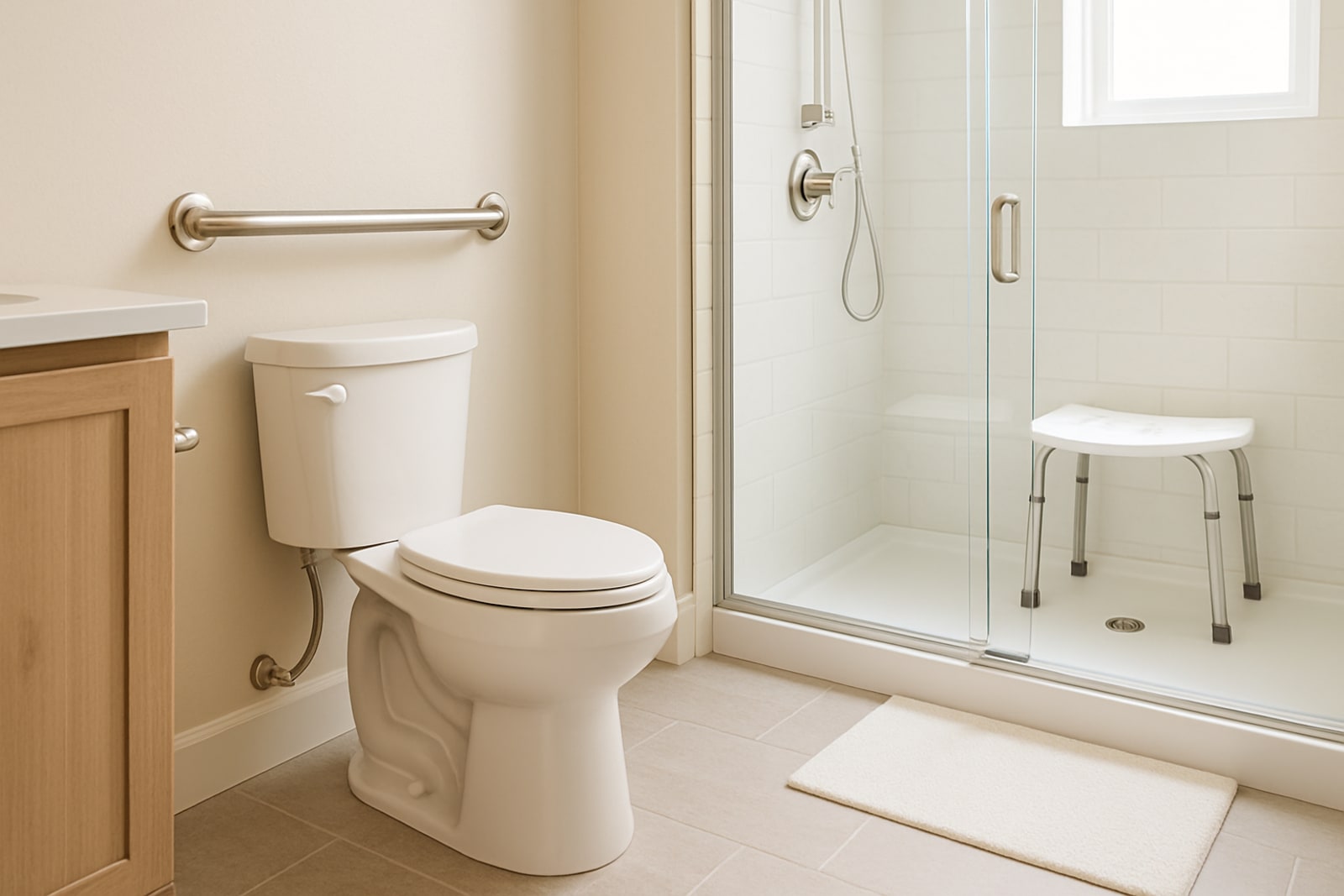
For mild instability: A simple grab bar mounted to the wall beside the toilet can make a significant difference. These need to be properly anchored into studs, a towel bar is not a grab bar, and it will pull out of the wall the first time someone puts real weight on it.
For moderate difficulty: An elevated toilet seat raises the height of the sitting surface by three to five inches, dramatically reducing how far your parent needs to lower themselves. This is one of the most cost-effective interventions available and can be installed in minutes.
For significant mobility challenges: A dignity lift is a patient lift designed specifically for the toilet. It helps your parent get on and off the toilet safely and comfortably, functioning similarly to a lift recliner. For someone who has reached the point where even an elevated seat is not enough, this can be the difference between independent toileting and needing a caregiver for every bathroom visit.
The key is matching the solution to where your parent is right now while thinking about where they might be in six to twelve months. Over-solving the problem is always better than under-solving it.
Pillar Two: Shower Entry and Exit, The Highest-Risk Transition
If the toilet is where mobility challenges first appear, the shower is where they become dangerous. Getting in and out of a wet, slippery enclosure while partially undressed is one of the highest-risk activities in any home. And unlike the toilet, where a fall might mean bruising, a fall in the shower can mean broken hips, head injuries, and emergency room visits.
Assessing the Shower Entry
The very first thing to look at is the transition point, how does someone actually get from the bathroom floor into the shower? This varies widely depending on the bathroom layout, and each configuration presents different challenges.
Step-over tub or shower: This is the most common and often the most dangerous. A traditional tub requires lifting your leg over a ledge that can be 14 to 18 inches high. For someone with balance issues, hip problems, or limited range of motion, this is a significant fall risk every single time they bathe.
Step-down shower: Some showers, particularly in older Florida homes, have a step down into the shower basin. The challenge here is that the floor levels are different on each side, creating an uneven transition that can catch people off guard.
Step-up shower: Less common but still present, step-up entries require lifting over a curb or threshold. The risk profile is similar to a step-over tub.
Level entry (zero threshold): This is the gold standard for accessibility. If your parent's shower already has a level entry, you are ahead of the game, but there are still factors to evaluate inside the shower itself.
Ask yourself these questions during your assessment:
- Is there a lip, ledge, or height change at the shower entry?
- Is the transition surface wet or slippery when the shower is in use?
- Does your parent need to hold onto something to step in or out?
- Is there a shower door that restricts movement or makes it difficult to assist if needed?
- Could a wheelchair or shower chair roll over the threshold if needed in the future?
Solutions That Do Not Require a Full Renovation
Here is where families often feel stuck. They see the problem, a dangerous shower entry, but they assume the only fix is a $15,000 to $30,000 bathroom renovation involving contractors, demolition, new plumbing, and weeks of disruption. That is simply not the case.
One of the most effective solutions we offer is a custom shower insert. This is a purpose-built insert that levels out the entire shower floor, eliminating the height difference at the entry point. It works exceptionally well with step-down showers, where the uneven transition is the primary hazard. For step-over situations, where the outside and inside are at different heights, a custom insert can be built for that configuration as well.
As we explain to families who are weighing their options:
"We can also build that custom insert for that as well. If somebody doesn't want to do that, you know, for whatever reason, mostly because it's the most expensive version of it, but it's still 1/10 the price of hiring a contractor to come in, break up the floor, do major work."
Let that sink in, one-tenth the price of a contractor renovation. For most families, that means spending hundreds to low thousands instead of tens of thousands, with far less disruption to the home.
Beyond the custom insert, there are several other shower entry solutions to consider:
- Sliding transfer bench: Your parent sits on the bench outside the shower, then slides across and into the shower. This eliminates the need to step over anything and provides a stable seated position throughout.
- Rotating sliding bench: Similar concept, but with a swivel seat that makes the transfer even smoother. Particularly helpful for someone with limited hip rotation.
- Grab bars inside and at the entry: For someone who is still ambulatory but needs support, properly placed grab bars at the shower entry and inside the shower can provide the stability needed for a safe transition.
- Roll-in shower chair: Once the floor is leveled with a custom insert, a roll-in shower chair becomes an option. Your parent or their caregiver can wheel them directly into the shower and back out. For someone who needs full assistance bathing, this is the safest approach available.
Inside the Shower: What Most People Miss
Even after solving the entry problem, the interior of the shower itself needs attention. Not every shower chair works in every shower. The structure of the enclosure, how wide it is, whether it has a built-in seat, what the floor texture is like, all dictate which equipment will actually fit and function safely.
Shower chairs come in several configurations, and choosing the wrong one can create new hazards instead of solving existing ones:
- Standard shower chair: Works in most standard showers, provides basic seated support
- Rotating shower chair: Allows your parent to turn without standing, reducing fall risk during bathing
- High-back reclining shower chair: For someone who wants more of a salon-style shower experience with full back and head support
- Roll-in shower chair: Best used with a level-entry or custom-insert shower for full wheelchair-to-shower transfers
The right choice depends entirely on your parent's specific mobility level, the physical dimensions of the shower, and whether a caregiver will be assisting. There is no universal answer, which is why a proper assessment matters.
Pillar Three: The Overall Bathroom Environment
The third pillar goes beyond specific fixtures and looks at the bathroom as a whole. Even if the toilet and shower are perfectly set up, the general environment can still present fall risks that are easy to overlook.
Common Environmental Hazards
Walk through your parent's bathroom with fresh eyes and look for these issues:
- Loose bath mats or rugs that can slide on tile flooring. These are one of the most common and preventable fall causes in any bathroom.
- Clutter on the floorscales, magazine racks, trash cans, step stools, anything that creates an obstacle between the door and the toilet or shower.
- Poor lighting, especially at night. Many falls happen during nighttime bathroom trips when visibility is low.
- Wet floors with no drainage path or non-slip treatment. After a shower, is there standing water between the shower and the toilet? Between the toilet and the door?
- Items stored at floor level that require bending down to reach, which can cause dizziness or loss of balance.
- Towel bars being used as grab bars. This is extremely common and extremely dangerous. A towel bar is attached with small screws into drywall. It will not hold a person's weight.
The Quick Environmental Checklist
Use this checklist to evaluate the overall bathroom environment:
- Flooring: Is the floor surface non-slip, even when wet? Are there any loose mats or rugs?
- Lighting: Is there adequate lighting at all hours? Is there a nightlight or motion-activated light for nighttime trips?
- Clear pathways: Can your parent walk from the door to the toilet and from the toilet to the shower without navigating around obstacles?
- Grab points: Are there properly mounted grab bars, or is your parent relying on towel bars, countertops, or door handles for support?
- Temperature: Is the hot water regulated to prevent scalding? Older adults often have reduced sensitivity to temperature.
- Emergency access: If your parent fell in the bathroom, could someone open the door from the outside? Many bathroom doors lock from the inside and swing inward, making them difficult to open if someone has fallen against them.
Why Every Bathroom Is Different
One of the biggest mistakes families make is ordering bathroom safety equipment online without understanding their specific bathroom layout. A shower chair that works perfectly in a 36-inch walk-in shower will not fit in a 30-inch tub enclosure. A grab bar placed at the wrong height or angle is almost as useless as no grab bar at all.
Everybody is different, and every bathroom is different. The structure of the shower, the height of the toilet, the layout of the room, the mobility level of the person using it, all of these variables interact with each other. What works for your neighbor's mother may not work for yours.
This is exactly why we take a consultative approach. When we assess a bathroom, we are not just looking at the room. We are looking at the person who uses it, how they move, what they can and cannot do independently, and what is likely to change in the coming months. The goal is always to find solutions that work today and can adapt as needs evolve.
What to Do Now
You do not need to solve everything at once. Here is a practical timeline to get started.
This Week
- Walk through your parent's bathroom using the three-pillar framework above. Take notes or photos.
- Watch how they actually use the space. Pay attention to what they grab, where they hesitate, and whether they avoid certain activities.
- Remove obvious hazards immediately: loose rugs, floor clutter, and anything that creates a tripping risk.
- Check every towel bar to see if anyone is using it as a grab point. If so, that is a red flag.
This Month
- Address the highest-risk area first. If the shower entry is dangerous, prioritize that. If toilet transfers are the bigger struggle, start there.
- Reach out for a professional assessment. A self-assessment gives you a strong starting point, but having an experienced eye evaluate the space will catch things you might miss and ensure the right equipment is matched to your parent's specific needs.
- Research your options before defaulting to a full renovation. In many cases, a custom shower insert, transfer bench, or elevated toilet seat can solve the problem at a fraction of the cost.
This Quarter
- Implement a complete bathroom safety plan that addresses all three pillars: toilet transfers, shower entry and exit, and the overall environment.
- Re-evaluate every 90 days. Mobility can change quickly, and what works today may need adjustment in three months.
- Think beyond the bathroom. If your parent needs bathroom safety modifications, there is a good chance other areas of the home could use attention too, the bedroom, hallways, and entryways all have their own risk profiles.
The Bottom Line
The bathroom does not have to be the most dangerous room in your parent's home. With a structured assessment focused on toilet transfers, shower safety, and the overall environment, you can identify risks before they become emergencies. And with solutions like custom shower inserts, transfer benches, and properly placed grab bars, you can make meaningful safety improvements without the cost and disruption of a full renovation.
Ready to get a professional set of eyes on your parent's bathroom? Contact #1 Medical Equipment & Supply for a consultative assessment. We will walk through the space with you, identify the specific risks, and recommend equipment that fits your parent's needs, your bathroom's layout, and your budget. Because everybody is different, and the right solution is always the one that matches the person actually using the room.