What Most Families Don't Know About Medical Equipment After a Hospital Discharge
What Most Families Don't Know About Medical Equipment After a Hospital Discharge
Your parent just got discharged from the hospital. You're exhausted, relieved, and overwhelmed all at the same time. A social worker or case manager mentioned something about medical equipment being sent to the house, a bed, a wheelchair, maybe a commode. You assumed someone was handling it. You signed some papers. And now you're home, staring at a bulky steel wheelchair that weighs 37 pounds and wondering how your 80-year-old mother is supposed to get that thing in and out of the car by herself.
This scenario plays out thousands of times every single week across the country. And the uncomfortable truth is that most families don't realize they had options, better options, until it's too late.
The durable medical equipment (DME) industry has a systemic problem. Most providers treat hospital discharge like a checkbox: receive the referral, match it to insurance-covered items, ship the standard equipment, and move on. The patient's actual living situation, their caregiver's physical limitations, the layout of their bathroom, and their emotional well-being rarely enter the equation.
Here's what you need to know about the gap between what most DME companies deliver and what your family actually needs, and the questions you should be asking before any equipment crosses your threshold.
The Hospital Discharge Equipment Gap Nobody Talks About
When a patient is discharged from a hospital, a referral for medical equipment is typically generated by the care team. That referral gets sent to a DME provider, sometimes one the family chose, sometimes one assigned by the insurance plan. And this is where the process breaks down for most families.
"What a lot of other companies do is they kind of just use the 'you get what you get and don't get upset' method, where with the insurance plan, these would be covered items, this is what you get."
That's the industry standard. Insurance says you qualify for a semi-electric hospital bed, a steel manual wheelchair, and a basic commode. Those items get delivered, sometimes used, sometimes without any conversation with the patient or family at all, and the provider considers the job done.
The problem is that "covered" does not mean "right." A covered wheelchair might weigh 35 pounds when a 15-pound option exists that would actually let your spouse load it into the car safely. A covered hospital bed might be a twin-sized, bent metal frame with a used spring mattress when the patient has slept in a queen bed with their partner for 40 years. A covered shower chair might not even fit in the bathroom layout where it needs to go.
Why the Standard Approach Fails Families
The standard fulfillment model is built around insurance codes, not people. Providers look at the referral, match it to the cheapest covered item, and prioritize speed of delivery over suitability. There are a few reasons this happens:
- Reimbursement rates are extremely low. Medicare and advantage plans pay DME providers minimal amounts for equipment, often spread across a 13-month capitation cycle rather than a single payment. This creates pressure to fulfill orders as cheaply and quickly as possible.
- There's no financial incentive to consult. Spending 30 minutes on the phone understanding a patient's home environment, caregiver situation, and mobility needs doesn't generate additional revenue for most providers. So they skip it.
- Volume over relationships. Large DME companies process hundreds or thousands of referrals per week. Individual attention simply isn't part of the business model.
The result? Families receive equipment that technically meets the insurance requirement but fails the patient in practice. And nobody told them there was another way.
What a Consultative Approach Actually Looks Like
At #1 Medical Equipment & Supply, we do things differently, and it starts before any equipment ever leaves our facility.
"When we receive a referral, the first thing we do is we call the family or the patient. We get to understand who they are and what their needs are."
That phone call is everything. It's where we learn that the patient's spouse has arthritis and can't crank a manual bed height adjustment. It's where we find out that the bathroom has a narrow walk-in shower that won't accommodate a standard shower chair. It's where we discover that nobody in the household can safely assemble a commode from a box, let alone verify that it's been set up correctly and won't tip over.
Every patient is different. Every family is different. Every home is different. And the equipment needs to match.
The Questions That Change Everything
Here are the kinds of questions we ask on every single referral, questions that most DME providers never think to raise:
- Who is the caregiver? Is it a professional aide, or is it an aging spouse? What are their physical limitations? Can they lift a 37-pound wheelchair into a car trunk?
- What's your home layout? How wide are the doorways? What does the bathroom look like? Is there a step to get into the shower? Will a standard walker fit through the hallway?
- Who is setting up the equipment? Are you expecting the patient or their elderly partner to break down a box, read assembly instructions, and build a commode safely? That's a fall risk waiting to happen.
- What's the patient's sleep situation? Have they shared a bed with their partner for decades? Forcing them into a twin-sized hospital bed alone can be emotionally devastating during an already difficult time.
- What specific mobility challenges exist? Does the patient need help standing? Is balance an issue? Are they at risk for pressure wounds? Each answer points to a different type of equipment.
These are not complicated questions. But they require something that the standard DME fulfillment model doesn't offer: a conversation.
The Hospital Bed Example That Says It All
Nothing illustrates the gap between insurance-driven fulfillment and consultative care better than the hospital bed.
Under Medicare guidelines, patients who qualify for a home hospital bed receive what's called a semi-electric model. Here's what that actually means: a twin-sized, bent metal frame with a crank mechanism for height adjustment (about eight inches of range) and a spring mattress. Nine times out of ten, it's not even a new bed. It's a used product with a used mattress.
Now think about the person receiving this bed. They're coming home from the hospital in their worst physical state. They're sick, injured, or recovering from surgery. They've spent their entire adult life sleeping in a comfortable queen or king bed with their loved one. And now we're asking them to sleep alone in a used, twin-sized institutional frame.
Your home is not a hospital. Someone coming home to recover doesn't want to feel like their house has been turned into an institution. And their family doesn't want that either.
What Residential Medical Beds Offer Instead
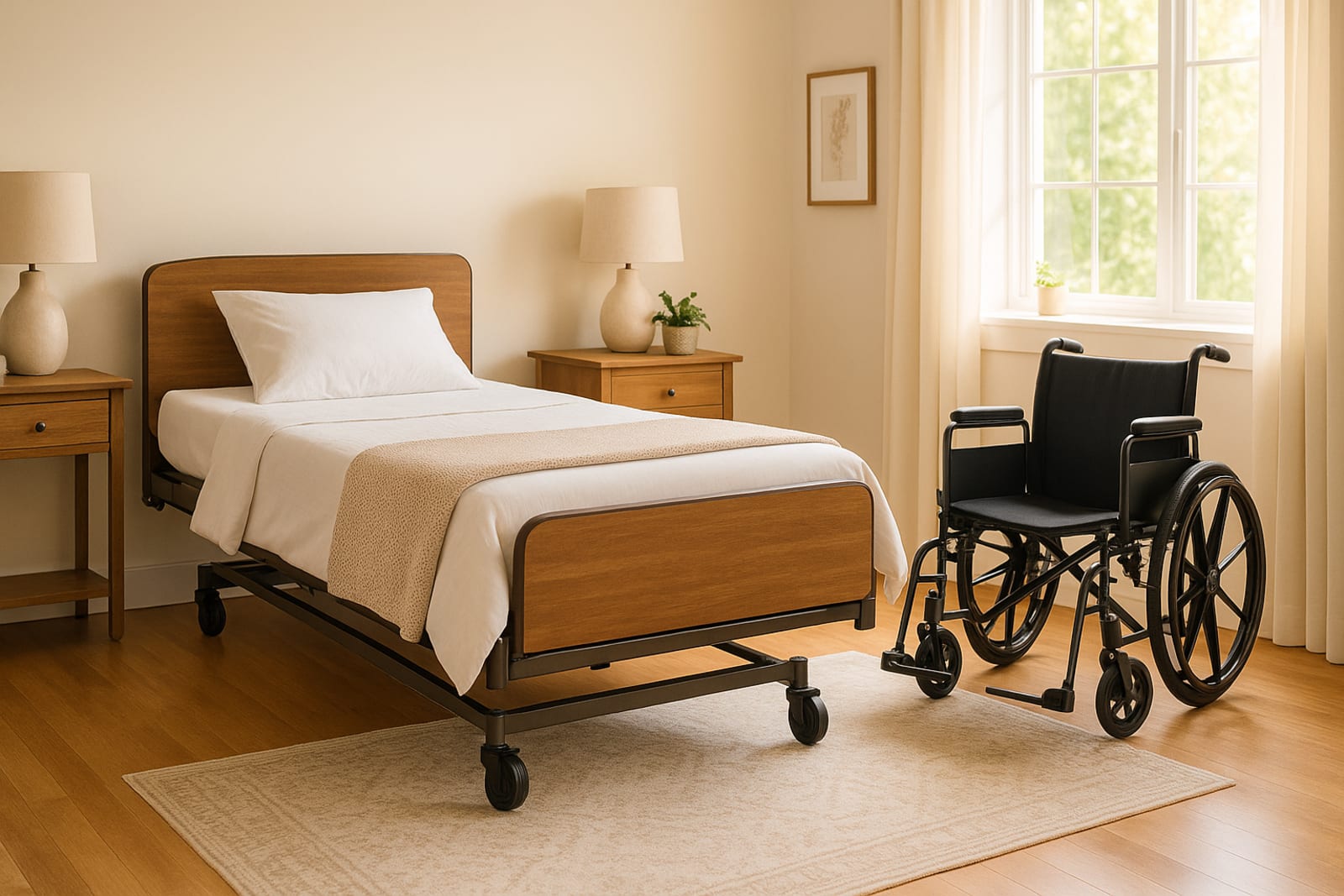
A residential medical bed, sometimes called a premium medical bed, is designed to look and feel like it belongs in your home while providing all the clinical functionality you need. Here's what that means in practice:
- True sizing options: Full, queen, and split king configurations so couples can continue sleeping together while each person gets their own independent adjustability.
- Mattress choices: Memory foam, innerspring, or combination mattresses tailored to the patient's comfort preferences and clinical needs.
- Advanced positioning: Electric high-low adjustment up to two feet, Trendelenburg tilt functionality for spinal relief and blood pressure regulation, and true zero gravity positioning.
- Low-profile designs: Beds that go all the way to the ground for patients at risk of falls.
- Aesthetic options: Colors, materials, and frame designs that look like bedroom furniture, not hospital equipment.
Studies consistently show that patients who receive care at home have better outcomes. Better rest leads to better recovery. When a spouse can sleep next to their partner and both people get what they need, the quality of care improves for everyone. The same way you invested in the best mattress you could afford throughout your life, that investment matters twice as much past the age of 75, and ten times more when you're dealing with a serious illness or injury.
The Amazon Trap: Why DIY Medical Equipment Is Risky
We understand the impulse. Your parent is being discharged, you need a shower chair and a commode by tomorrow, and Amazon can have it there in hours. It feels like the easiest solution. But here's what Amazon cannot do: ask you a single question about your situation.
Just recently, a client was preparing to order a shower chair and commode from Amazon for a family member coming home from the hospital. Before they clicked "buy," we asked a few simple questions that changed everything.
On the commode: There are multiple types of commodes with different seat positions, armrest configurations, and heights. Some have flip-back armrests. Some include a lift mechanism that helps the patient stand up. The "standard" commode Amazon would have shipped might have been the wrong height, too unstable for the patient's weight, or missing a critical safety feature for someone who struggles to stand.
On the shower chair: What's the design of the bathroom? If the shower is narrow, a standard chair might block the patient from safely getting in and sitting down. Would a rotating shower chair, where the patient sits and swivels into position, be safer? What about a rolling shower chair for a larger bathroom? The details on something as simple as a shower chair might make the difference between your loved one falling or not.
Amazon is not going to explain the difference in product quality. It's not going to tell you why one commode costs $20 more than another and whether that difference could prevent a serious injury. It's not going to ask who's assembling the equipment and whether they can do it safely. That's all on you.
We take the opposite approach. We explain the differences, walk through the options, and make a recommendation based on experience, then let you decide the best product for your family.
What You Don't Know About Insurance Coverage Could Cost You
Insurance coverage for medical equipment confuses everyone, and the misconceptions can be expensive. Here are the biggest gaps in understanding that catch families off guard.
Clinical Documentation Is the Gatekeeper
Before you even get to the question of what your insurance covers, there's a more fundamental issue: your clinical documentation. If the doctor's notes, discharge paperwork, and medical records don't meet the specific requirements for an item, you could be financially responsible for it, or the equipment could be picked up and taken away after it's delivered.
Most DME companies don't explain this. They process the referral, deliver the equipment, and if the claim gets audited and denied months later, the patient gets the bill. A responsible provider reviews the documentation upfront and has an honest conversation about what can and cannot be supported by the clinical record.
Medicare vs. Advantage Plans: A World of Difference
Traditional Medicare, Medicare Advantage PPO, and Medicare Advantage HMO plans all work differently when it comes to equipment coverage. The reimbursement rates, approval processes, and covered items can vary dramatically. Many families assume their "Medicare" covers everything the same way, and that's simply not the case.
The 13-Month Surprise
Most people don't realize that DME coverage isn't a one-time payment. It's typically a 13-month capitation cycle, meaning the insurance pays in installments over more than a year. If something happens within those 13 months, the equipment breaks, the patient's needs change, or the provider needs to pick it up, there can be unexpected financial consequences for the patient.
The Hard Truth About Medicare's Purpose
Here's something that's difficult to hear but important to understand: the job of Medicare is to give people enough equipment to live their life, not to be comfortable. That's a critical distinction. Medicare will cover a used twin hospital bed with a crank. It will not cover a queen-sized residential medical bed with memory foam and zero-gravity positioning. The gap between "functional" and "comfortable" is where families need to make informed decisions, and where having a knowledgeable equipment provider makes all the difference.
What To Do Now
If you or a family member is facing a hospital discharge, or if you're already home with equipment that doesn't feel right, here's a practical timeline for taking action.
This Week
- Pick up the phone before accepting any equipment delivery. Call your DME provider and ask them specific questions: What alternatives exist for the items being delivered? What's the weight of the wheelchair? Who is going to set up the equipment? If they can't answer, or won't take the time, that tells you everything.
- Evaluate what's already in your home. Is the current equipment actually working for the patient and the caregiver? Is the bed comfortable? Can the wheelchair be loaded into the car? Is the shower chair safe for the bathroom layout?
- Document the home environment. Take photos and measurements of the bathroom, doorways, and bedroom. This information is critical for selecting the right equipment.
This Month
- Review your insurance coverage with your provider. Understand whether you're on traditional Medicare or an advantage plan, what type (PPO vs. HMO), and what the specific coverage limits are for DME. Ask about the 13-month capitation cycle and what happens if you need to exchange equipment.
- Get a consultative assessment. Work with a provider who will evaluate the patient's full situation, not just the referral code. This includes caregiver capabilities, home layout, mobility challenges, and quality-of-life goals.
- Explore premium and upgraded options. If insurance-covered equipment isn't meeting your family's needs, ask about residential medical beds, lightweight wheelchairs, rotating shower chairs, and other solutions that may be available through private pay or long-term care insurance.
This Quarter
- Reassess as the patient's condition changes. Recovery isn't static. Equipment needs evolve as patients heal, develop new challenges, or transition from acute recovery to long-term care. Schedule a follow-up conversation with your provider to make sure everything still fits.
- Investigate long-term care insurance benefits. If you have a long-term care policy, many premium equipment options may be covered. This is an underutilized resource that can dramatically improve quality of life.
- Build a relationship with your equipment provider. The best outcomes happen when your DME provider knows your family, understands the patient's history, and can proactively recommend adjustments as needs change.
The Bottom Line
Hospital discharge is one of the most vulnerable moments for patients and families, and the medical equipment you bring into your home matters far more than most people realize. The difference between a generic, insurance-driven delivery and a consultative, needs-based approach can mean the difference between a safe recovery at home and a preventable fall, an uncomfortable night, or a piece of equipment that sits in the corner unused. You deserve a provider who picks up the phone, asks the right questions, and makes sure the equipment actually fits your life.
If your family is navigating a hospital discharge or you're not satisfied with the medical equipment currently in your home, we're here to help. Contact #1 Medical Equipment & Supply at 1medsupply.com or give us a call to schedule a consultation. We'll start with the most important step: getting to know you and your family's needs.